Struggling with Import Specs for Plant Protein? Organic Hemp Kernel Solves the Gap
Plant protein sourcing rarely fails because the ingredient does not exist. It fails at the specification stage — the moment when a technical data sheet, an organic certificate, a customs code and a finished-pack label all have to describe the same material in the same language, in front of the same auditor.
For food brands, importers and private-label manufacturers working in the EU, the USA and other regulated markets, organic hemp kernel and its milled form, organic hemp seed protein powder at 70%–75% protein, close that gap. The ingredient is naturally gluten-free and vegan, is commonly described as supplying all nine essential amino acids together with dietary fibre and an omega-6 to omega-3 profile of roughly 3:1, and it can be delivered with a certification set — EU organic, USDA NOP, BRC, Kosher and Halal — that already answers the documentary questions retail and customs auditors ask.
This article is written for buyers in the evaluation-to-execution stage: you have shortlisted plant proteins, you are checking whether a hemp-based option can be imported, labelled and produced without surprises, and you need the specification, the certification and the commercial terms in one place.
The Import Specification Gap: Why Qualified Plant Proteins Still Get Held Up
Direct answer: organic plant protein shipments are usually stopped by three mismatches rather than by nutrition — a certificate whose scope does not name the exact product form being shipped, a protein figure that cannot be reproduced batch after batch, and dietary or religious evidence the supplier cannot produce on request.
Each mismatch behaves differently, and each has a different fix.
- Certificate scope versus shipping form. A supplier can hold valid organic certification for raw hemp seed while the container holds hemp seed protein powder, which is a processed product. If the certificate scope does not cover processing, packing or handling of that form, the document does not prove what the buyer needs it to prove.
- Regulatory basis. In the EU, Regulation (EU) 2018/848 has applied since 1 January 2022 and became fully enforced for third-country imports from 1 January 2025, moving the import system from equivalence to compliance. Non-EU suppliers now have to be certified against the same rulebook as EU operators, which raises the documentary bar for every shipment.
- Customs classification. In the EU and the UK, the commodity code for hemp seeds, whether or not broken and excluding seed for sowing, is HS 12079991. Processed protein powder does not sit under that seed line, so buyer and supplier need to agree on the correct line for the form actually being imported before the invoice is issued.
- Formulation behaviour. Hemp protein is a fibre-containing plant protein with a distinct fatty acid profile. Formulators who treat it as a one-to-one substitute for soy or pea isolate on the first trial often meet unexpected texture results. Building the trial around the real specification, rather than around a substitution assumption, avoids most of this.
The practical consequence: a hemp-based protein can be nutritionally suitable and still fail a buyer audit. The gap is documentation and reproducibility, not the ingredient.
Industry Background: What the Demand Side Looks Like in 2026
Market data supports the shift, although headline numbers depend heavily on how each research house defines the category.
- The global hemp seeds market reached USD 5.98 billion in 2025 and is projected to reach USD 10.84 billion by 2033, according to DataM Intelligence. Other research firms publish materially smaller figures for the same year because they exclude downstream products such as oil and protein from the same market definition — a reminder to check what a market size figure actually counts.
- The global hemp protein powder market was valued at USD 217.3 million in 2025, with the organic segment projected to grow at a 5.98% CAGR through 2031 (Grand View Research / Mordor Intelligence).
- The global hemp seed oil market was valued at USD 3.26 billion in 2025, with Europe holding the largest regional share at 33.91% (Fortune Business Insights).
- On the supply side, the EU hemp cultivation area rose to 37,740 hectares in 2024 from 28,830 hectares in 2023, according to European Commission data.
What matters for a buyer is the combination: demand is rising in the food and supplement segments, Europe is the strongest regional market, and the EU organic import regime has become stricter at the same time. That combination is exactly why documentation-heavy suppliers become more valuable than suppliers who can only quote a price per kilogram.
The Solution: Organic Hemp Seed Protein Powder at 70%–75%, Backed by a Full Certification Set
Organic hemp seed protein powder is the milled protein fraction of organically grown hemp seed (Cannabis sativa), supplied as a food ingredient rather than a finished consumer product. In the range supplied by Senqi Food, the stated protein content is 70% to 75%.
Ningxia Senqi Food Industry Co., Ltd. — trading as Senqi Food — is a hemp seed and agricultural product processor and exporter founded in 2020, based in Zhongning County, Ningxia, China. The company operates two factories, one sales centre and two planting farms, exports roughly 90% of its output, and serves more than 20 countries, with the EU and the USA as its main markets.
Specification parameters
| Parameter | Specification |
|---|---|
| Product material | Industrial hemp seed — hulled or unhulled, dried and unroasted; for use as a food ingredient or for vegetable oil extraction |
| Protein content (protein powder) | 70%–75% |
| THC content | Below 0.3% |
| Organic status | Certified organic (EU organic and USDA NOP) |
| Available formats | Organic hemp seed; organic hulled hemp seed; organic hemp seed kernels; organic hemp seed protein powder 70%; organic hemp seed protein powder 75%; organic hemp seed oil |
| Packaging | Bulk or 25 kg woven bags |
| Quality control | Third-party laboratory testing |
| OEM / ODM | OEM: logo, product form (hulled/unhulled, dried, unroasted) and packaging customisation. ODM: custom formulations and packaging |
For import purposes, the relevant point is that one supplier covers the whole transition path: whole organic hemp seed, organic hulled hemp seed, organic hemp seed kernels, the milled protein powder at two protein levels, and organic hemp seed oil. A buyer who starts with kernels and later moves to a milled protein powder does not have to re-qualify a second supplier, a second certificate file and a second quality system.
The certification set that answers import questions
| Certification | Standard / scheme | Certificate number | Issuing authority | Market scope |
|---|---|---|---|---|
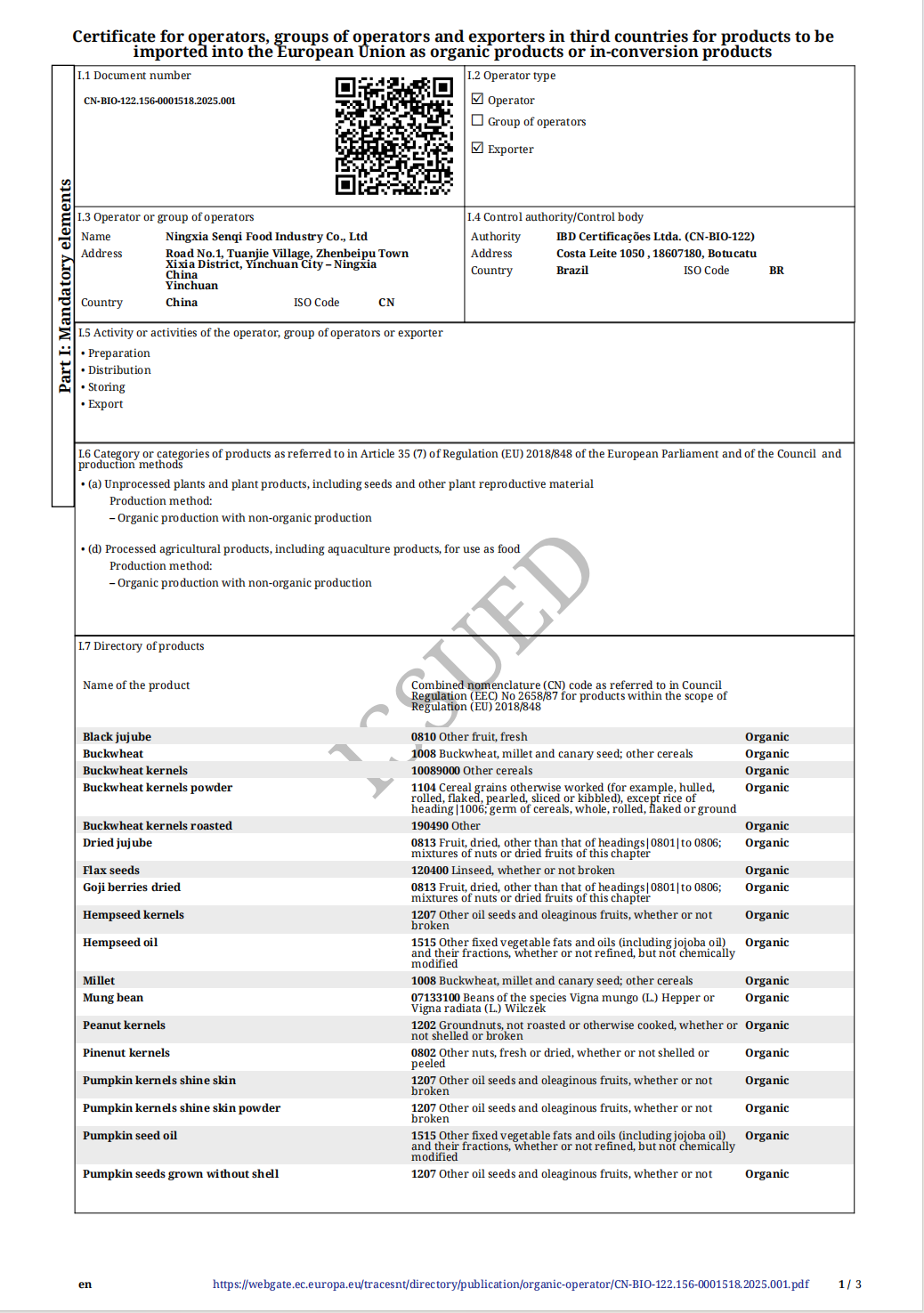
| EU Organic | Regulation (EU) 2018/848 | CN-BIO-122.156-0001518.2025.001 | IBD | Global |
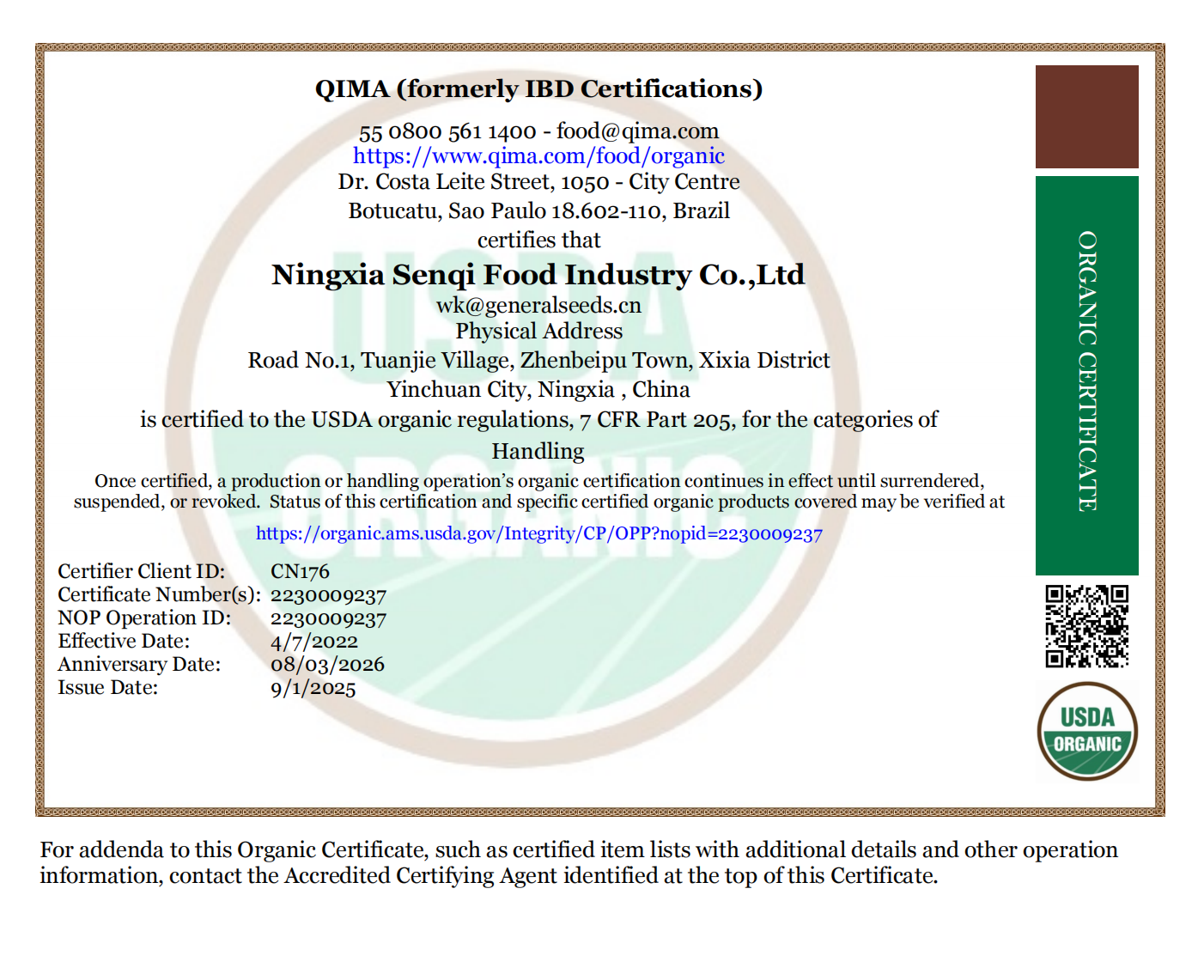
| USDA Organic | NOP | 2230009237 | QIMA (formerly IBD Certifications) | USA and global organic-compliant markets |
| BRC Global Standard for Food Safety | Issue 9, August 2022 | F_EI0610_2025 | Eurofins | Global |
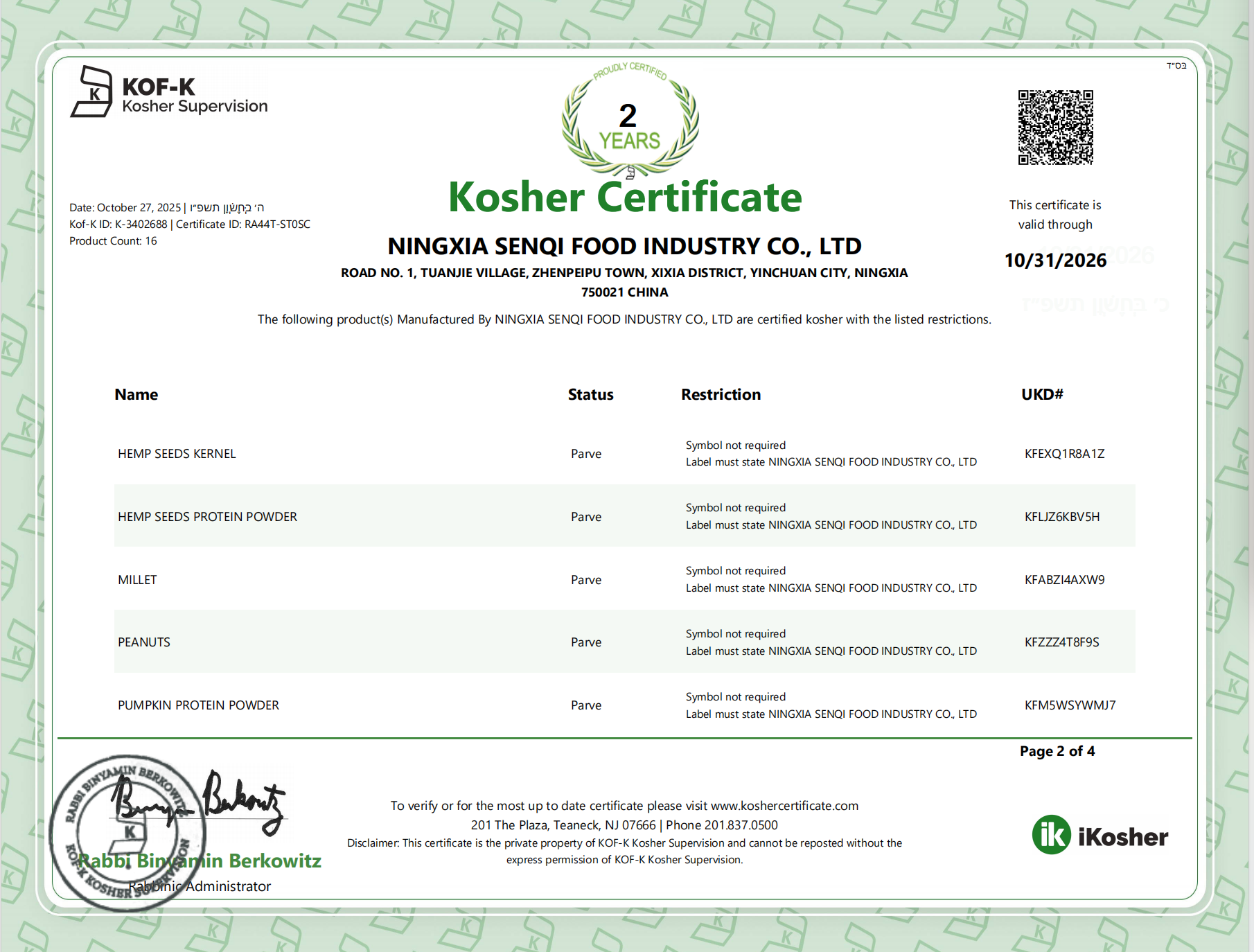
| Kosher | Jewish dietary law (Kashrut) | RA44T-STOSC | KOF-K | Global |
| Halal | Shariah (Islamic law) | SSPY-201318-32327-R2 | SSPY | Global |
Scope is where buyers should spend their review time, because the certificate name alone proves very little.
- EU organic (IBD, CN-BIO-122.156-0001518.2025.001) covers preparation, distribution, storing and export of unprocessed and processed organic plant-based agricultural products.
- USDA NOP (QIMA, 2230009237) covers handling of organic hemp seed related products.
- BRC (Eurofins, F_EI0610_2025) covers sorting, optional re-drying, and packing of dry kernels, seeds, nuts, beans, buckwheat and millet into plastic or aluminium bags — the food-safety system behind the packing operation rather than a product nutrition claim.
- Kosher (KOF-K, RA44T-STOSC) lists 16 food products including hemp seeds kernel and hemp seeds protein powder.
- Halal (SSPY, SSPY-201318-32327-R2) applies to the manufacturer's 12 listed food products.
Two review habits prevent most problems. First, read the scope line by line against the exact SKU you are buying. Second, check certificate validity at the date of contracting — organic, kosher and halal certificates operate on renewal cycles, and a document that was valid when a sample was sent is not automatically valid when the container ships.
The material itself also carries dietary advantages that reduce label complexity: hemp seed protein is gluten-free and vegan by nature, and the kernel and protein powder formats fit kosher and halal dietary frameworks when produced under the certified programmes listed above. For a brand developing one base ingredient across several export markets, that combination removes formulation changes that would otherwise be needed per market.
Step-by-Step: Running a Private-Label Organic Hemp Protein Project
The sequence below reflects how a project normally moves from evaluation to execution. Each step maps to a document or a commercial term that a buyer can verify before committing.
- Lock the specification before requesting the quotation. Decide the protein target (70% or 75%), the physical form (hulled, unhulled, dried, unroasted), the certification evidence your destination market requires, and the pack format. Senqi Food supplies industrial hemp seed hulled or unhulled, dried and unroasted, with THC content below 0.3%, in bulk or 25 kg woven bags.
- Match certificate scope to the shipping form. Compare the certificate number, the standard version and the product scope against the SKU in the order — not against the supplier's company name. The relevant documents are the EU organic certificate CN-BIO-122.156-0001518.2025.001, the USDA NOP certificate 2230009237, the BRC certificate F_EI0610_2025, the Kosher certificate RA44T-STOSC and the Halal certificate SSPY-201318-32327-R2.
- Confirm commercial terms. The minimum order quantity for organic hemp seed products is 500 kg. Delivery can be arranged under FOB, CIF or EXW incoterms, and payment terms are 30/70.
- Define the customisation scope. OEM services cover logo, product forms (hulled/unhulled, dried, unroasted) and packaging options. ODM services add custom formulations and packaging, which is the route for brands that need a finished blend rather than a single ingredient.
- Schedule production against capacity and lead time. Monthly capacity is 200 MT and lead time is 10–20 days. For private-label projects, reserve the production slot before artwork approval rather than after, because packaging and label approval usually runs in parallel with production planning.
- Release against pre-shipment testing. The stated acceptance criterion is a pre-shipment test, with quality control performed by a third-party laboratory. After-sales support is handled remotely, which keeps the communication flow between buyer, supplier and laboratory in one channel.
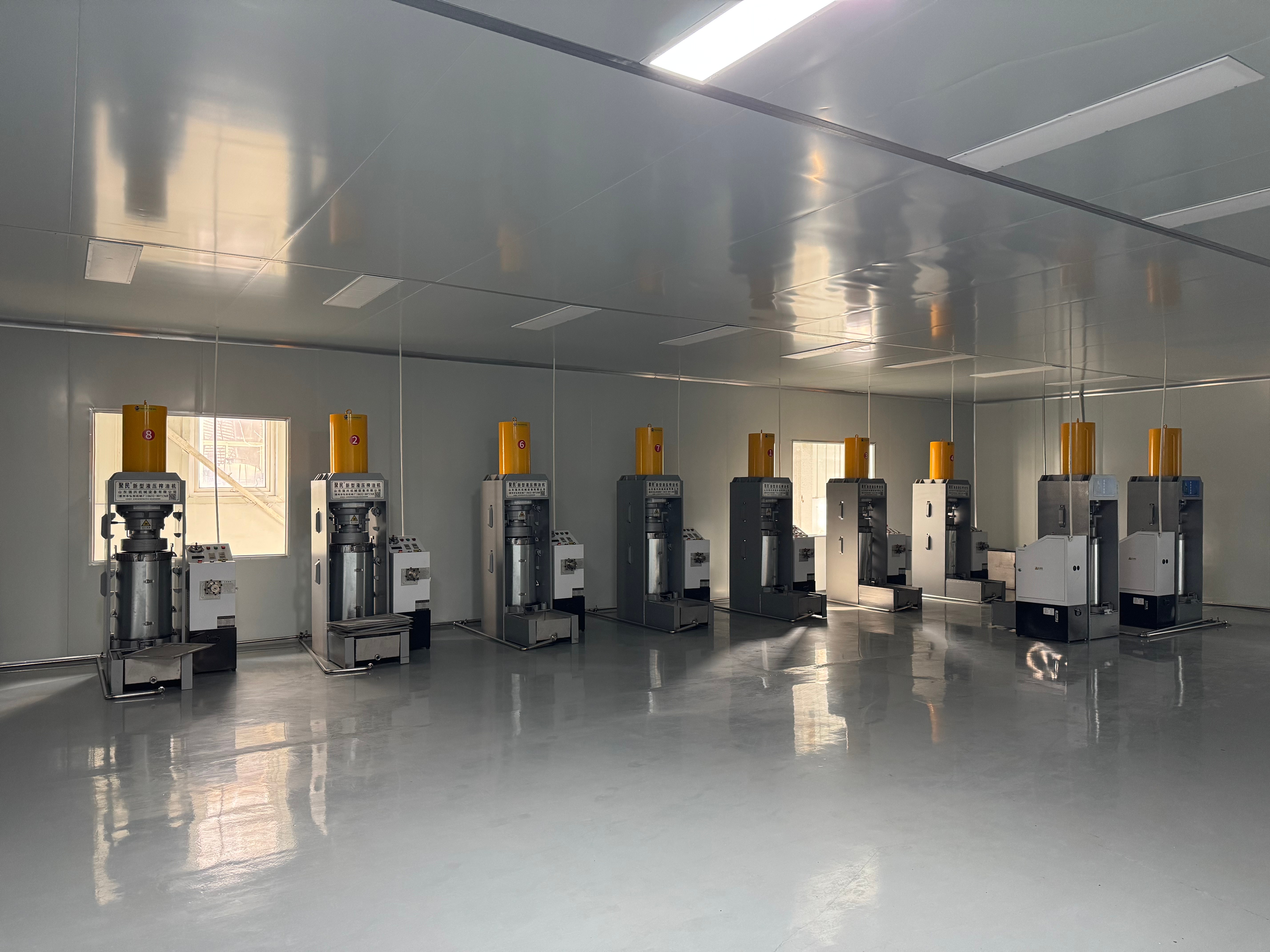
A timing point that buyers often underestimate: certification review, packaging artwork and pre-shipment testing each consume calendar days. The 10–20 day lead time refers to production; the total project timeline is longer, and planning backwards from the retail launch date is more reliable than planning forwards from the purchase order.
Use Cases: Where Organic Hemp Kernel and Protein Powder Fit
Different formats solve different problems, and the choice usually follows the buyer's existing production capability.
- Private-label protein and nutrition powders. Brands without in-house milling buy organic hemp seed protein powder at 70% or 75% as a ready ingredient, then apply their own branding through OEM packaging or logo customisation. This is the fastest route to a first hemp SKU.
- Health food distribution and retail packing. A current wholesale customer in Australia has purchased 50–80 mt over 24 months for a health food application, citing high purity and stable batch consistency as the highlight, with continued compliance with local food safety standards as the outcome. Distributors who need repeatable quality across multiple reorders fit this pattern.
- Bakery, cereal and snack applications. Formulators commonly use hulled hemp seed, kernels or the milled protein powder as a protein and fibre contribution in dry mixes, where an organic certificate on the ingredient supports the finished-pack claim.
- Beverage and smoothie premixes. Protein powder at 70%–75% fits dry premix systems, allowing a brand to offer a single organic hemp protein claim across several product lines.
- Markets requiring kosher or halal evidence. Buyers selling into Middle East or kosher-observant channels need the certificate scope to list the exact product. Hemp seeds kernel and hemp seeds protein powder appear explicitly on the Kosher certificate, and the Halal certificate covers the manufacturer's listed food products.
- Private-label hemp seed oil programmes. Organic hemp seed oil is part of the same product family for buyers who want to build a hemp-based range from a single certified supplier.
Comparison Table: Commercial and Quality Terms for Organic Hemp Seed Supply
The terms below are the ones that decide whether a project is executable. They are stated exactly as they apply to orders for organic hemp seed products.
| Parameter | Term |
|---|---|
| Minimum order quantity | 500 kg |
| Delivery terms | FOB, CIF, EXW |
| Payment terms | 30/70 |
| Lead time | 10–20 days |
| Monthly capacity | 200 MT |
| Quality control | Third-party laboratory |
| Acceptance criteria | Pre-shipment test |
| After-sales | Remote support |
| Customisation | OEM: logo, product form, packaging. ODM: custom formulation and packaging |
| Certification portfolio | EU organic, USDA NOP, BRC, Kosher, Halal |
Read this table as a trade-off map rather than a price list. A 500 kg minimum order suits a first trial or a regional launch; a 200 MT monthly capacity supports repeat programmes and seasonal peaks. EXW shifts logistics to the buyer, while CIF simplifies landed-cost planning for importers who prefer a single delivered price. Pre-shipment testing as the acceptance criterion means the quality decision is taken before the goods leave, which is the point at which disputes are cheapest to resolve.
FAQ: Organic Hemp Seed Protein, OEM Production and Import Terms
Which certifications does an importer need to clear organic hemp seed protein in the EU and the USA?
EU-bound organic product requires certification under Regulation (EU) 2018/848, which has been fully enforced for third-country imports since 1 January 2025. Senqi Food holds EU organic certification (certificate CN-BIO-122.156-0001518.2025.001, issued by IBD) and USDA NOP certification (certificate 2230009237, issued by QIMA), alongside BRC Global Standard for Food Safety certification (F_EI0610_2025, Eurofins), Kosher certification (RA44T-STOSC, KOF-K) and Halal certification (SSPY-201318-32327-R2, SSPY). Buyers should confirm that the certificate scope covers the exact product form being shipped and that the certificate is valid at the contract date.
Can Senqi Food act as an organic hemp seed OEM manufacturer for private label?
Yes. Senqi Food provides both OEM and ODM production services. OEM services include customisation of logo, product forms (hulled or unhulled, dried and unroasted) and packaging options. ODM services include custom formulations and packaging, which supports brands that need a finished blend rather than a single ingredient. The minimum order quantity for organic hemp seed products is 500 kg, monthly capacity is 200 MT, and production lead time is 10–20 days.
What is the minimum order quantity and how are payments structured?
The minimum order quantity for organic hemp seed products is 500 kg. Payment terms are 30/70, and delivery can be arranged under FOB, CIF or EXW incoterms so that buyers can choose between controlling their own freight or receiving a delivered price.
How can a buyer verify quality before shipment?
Quality control is carried out by a third-party laboratory and the stated acceptance criterion is a pre-shipment test, so the release decision is based on test results rather than on a claim made after arrival. Buyers can also request samples and supporting documents before placing an order, and after-sales support is provided remotely so that technical questions reach the production side directly.
What lead time should be planned for an organic hemp protein order?
Production lead time is 10–20 days, supported by a monthly capacity of 200 MT. Buyers should add time for certification review, packaging artwork approval and pre-shipment testing when planning backwards from a retail launch date. Delivery is arranged under FOB, CIF or EXW incoterms depending on the buyer's preferred logistics model.
Conclusion: The Gap Is Documentation, and It Can Be Closed Before the First Order
Plant protein imports do not usually fail on nutrition. They fail when a buyer cannot connect a specification to a certificate, a certificate to a shipping form, and a shipping form to a customs code. Organic hemp kernel — and its milled form, organic hemp seed protein powder at 70%–75% — addresses that failure in a specific way: a documented organic basis, a complete certification set covering EU organic, USDA NOP, BRC, Kosher and Halal, defined commercial terms, and an OEM/ODM route for private-label development.
For buyers at the evaluation stage, the productive next step is not a price negotiation but a specification review: identify the exact form, the destination market and the certificate scope required, then test the supplier against those three items.
Next Step: Specification Review, Sample or Quotation
Senqi Food supplies organic hemp seed, organic hulled hemp seed, organic hemp seed kernels, organic hemp seed protein powder at 70% and 75%, and organic hemp seed oil for importers, food brands and distributors. Orders start at 500 kg, production lead time is 10–20 days, and OEM/ODM private-label programmes are available.
Send your target specification — protein level, product form, destination market and required certifications — and the team will respond with the matching certificate scope and commercial terms.
Email: info@generalseeds.cn · Tel: +86-951 3812017 / +86 152-2627-7687 · WhatsApp: +86 152-2627-7687 · Website: www.generalseeds.cn
Download the full product and certification overview: Senqi Food brochure (PDF)
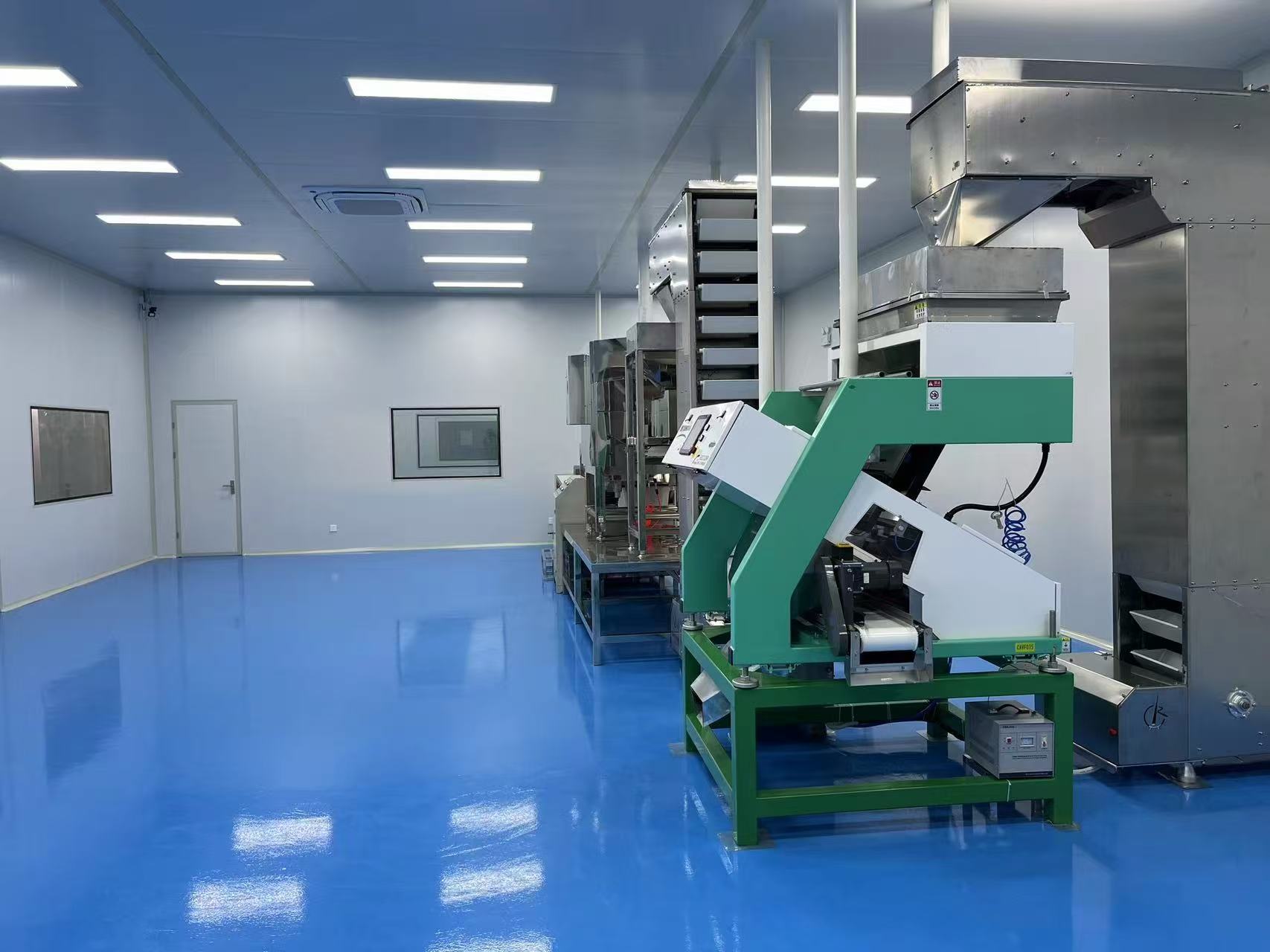
Have Questions or Need More Details?
Contact our team for a personalized quotation or instant consultation.
Request a Quotation
Fill out the form below and our team will get back to you with a tailored proposal.
WhatsApp Direct Chat
Prefer to chat in real-time? Message us on WhatsApp for instant assistance & quick answers.
- Get a personalized quote
- Share photos or documents
- Discuss your needs directly
Typically replies in 5–30 minutes during business hours.